

The AI Infrastructure Triad
A framework for the three priorities every region is balancing as it builds AI infrastructure, whether it admits it or not


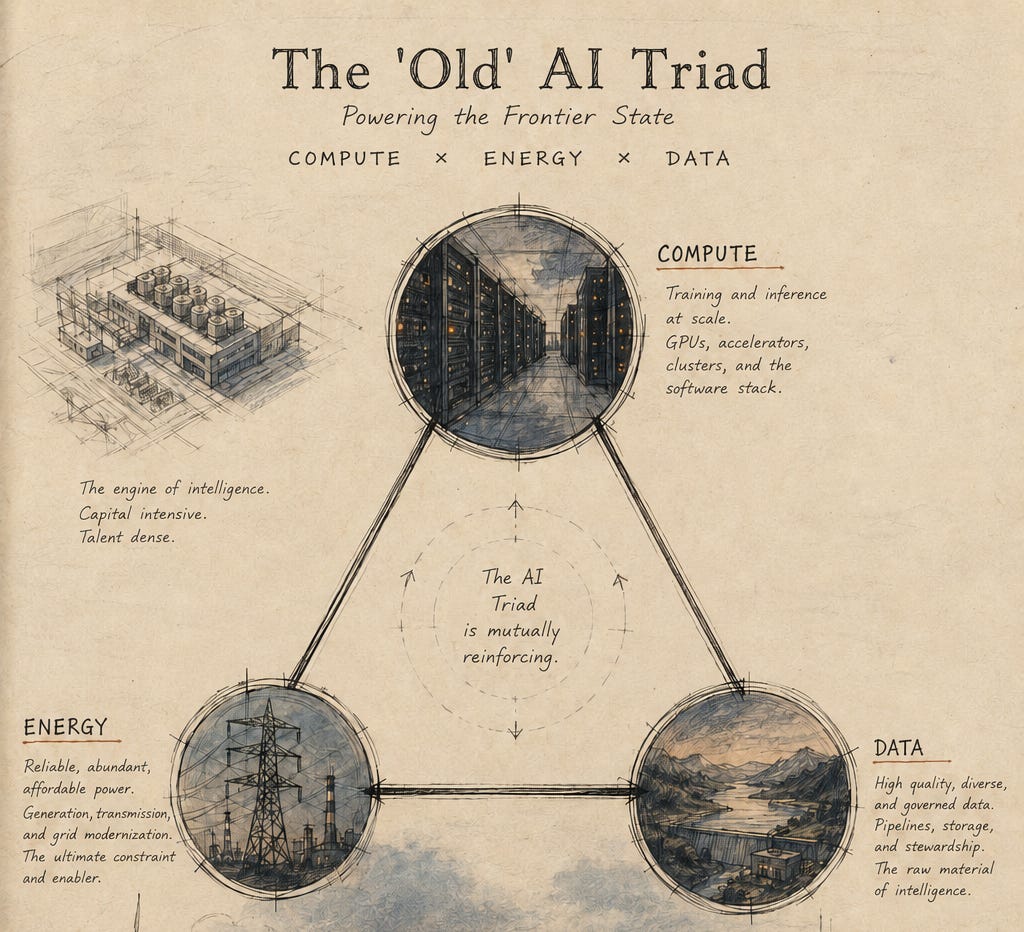
An AI Infrastructure Triad is more nuanced than recent thinking on ‘AI Triads’:
In January 2026, two of the most visible technology companies in the world did something that looked like the opposite of profit maximization.
Microsoft published a plan it called “Community-First AI Infrastructure”: pay the full electricity cost of its data centers, replenish more water than it consumes, partner with trade unions on local hiring, pay full property taxes while forgoing the abatements municipalities routinely offer. A week later, OpenAI unveiled “Stargate Community,” promising not to raise local electricity costs and, in Texas, investing a billion dollars to build a 1.2-gigawatt campus with its own dedicated power. By March, the White House had added a “ratepayer protection pledge.”
Why would firms that spent two years lobbying to remove regulatory barriers suddenly take on community obligations no law required?
That question is the starting point of a new paper Paulo Carvão and I have just published in AI & Society (also published as a Working Paper at Harvard’s Mossavar-Rahmani Center for Business & Government). The answer, we argue, is that a set of physical constraints has quietly rewritten the political economy of AI infrastructure, and the frameworks policymakers rely on were never built to see them.
The end of AI as a purely digital thing
The assumption inherited from the software era, that digital infrastructure scales without serious material inputs, is over. Training a frontier model now takes electricity sufficient to power a city and significant water for cooling. Global data center electricity use hit roughly 415 terawatt-hours in 2024 and is projected to more than double by 2030. In the United States, data centers already draw more than 4 percent of all electricity. In Northern Virginia, they consume around 26 percent of the regional load.
These are hard limits on where infrastructure can go, how fast, and who pays. The dominant policy response treats them as friction to be cleared. We think that instinct is mistaken, and the framework explains why.
The AI Infra Triad is akin to a Trilemma
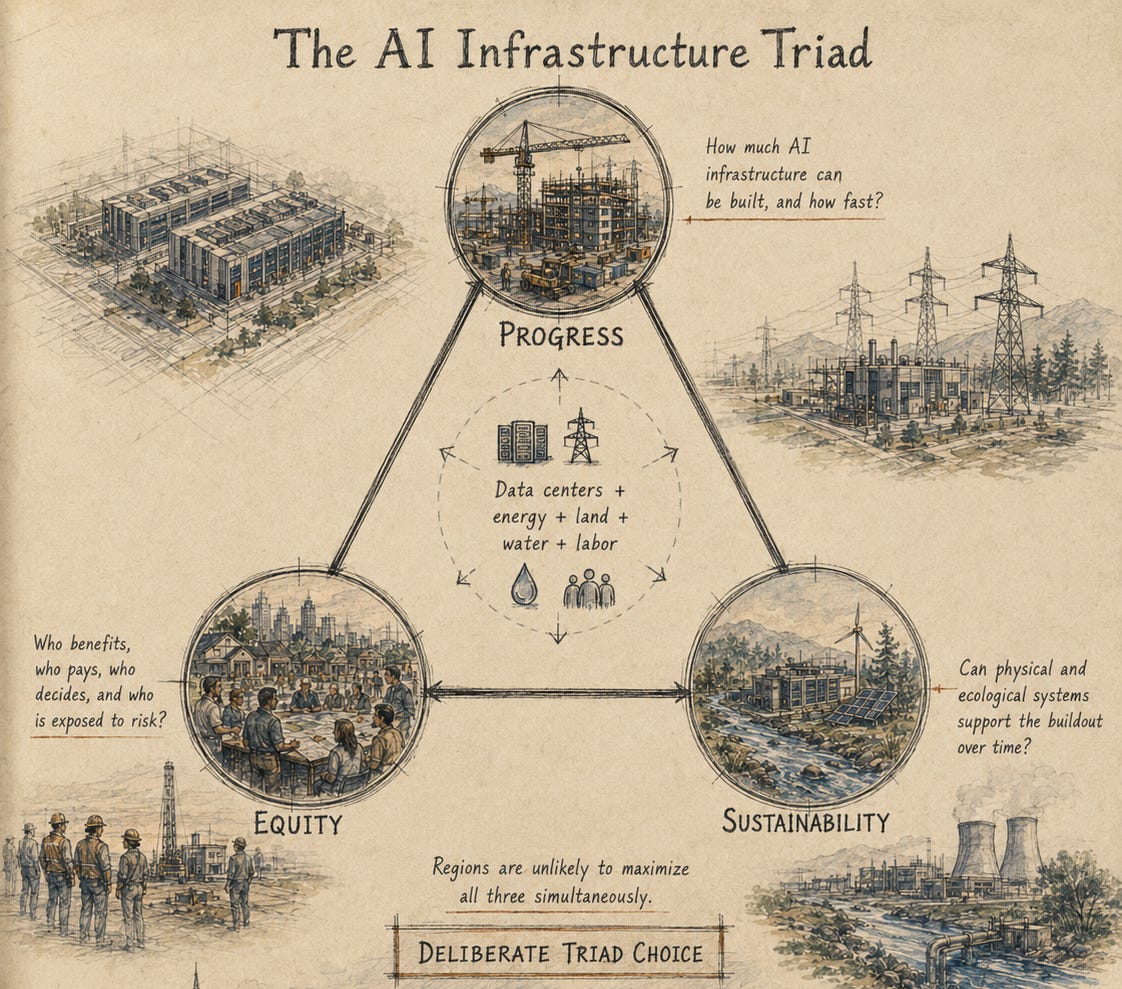
The AI Infrastructure Triad holds that a region balancing AI infrastructure faces three competing priorities that are unlikely to be maximized at once:
Progress is the scale and speed of deployment: capacity, compute, time-to-market, the rapid expansion of energy and network systems. Its constituency is firms, investors, and governments chasing technological leadership.
Sustainability is whether the energy, water, and land systems can support the buildout over time: grid reliability, renewable integration, water stewardship, carbon intensity. It serves the physical systems everyone ultimately depends on.
Equity is how the benefits and burdens are distributed: who gets the jobs and tax revenue, and who absorbs the higher electricity bills, the land-use pressure, the grid strain. It serves workers, host communities, and ratepayers.
Push hard toward one and you usually give something up at another. A state can impose strict efficiency standards (good for Sustainability) while letting the costs land on ratepayers (bad for Equity). The triad does not point to a single right answer. It makes the trade-off visible before it gets locked in.
Why “innovation vs. regulation” misses the real fight
Most AI policy debate runs on a single axis: more rules or fewer. Drawing on a coded dataset of 10,068 public comments to the 2025 U.S. AI Action Plan, the paper shows the actual disagreement is multi-dimensional. Stakeholders differ not over how much governance AI needs, but over which values should guide infrastructure decisions and who should bear the costs. That is a distributional contest dressed up as a procedural one.
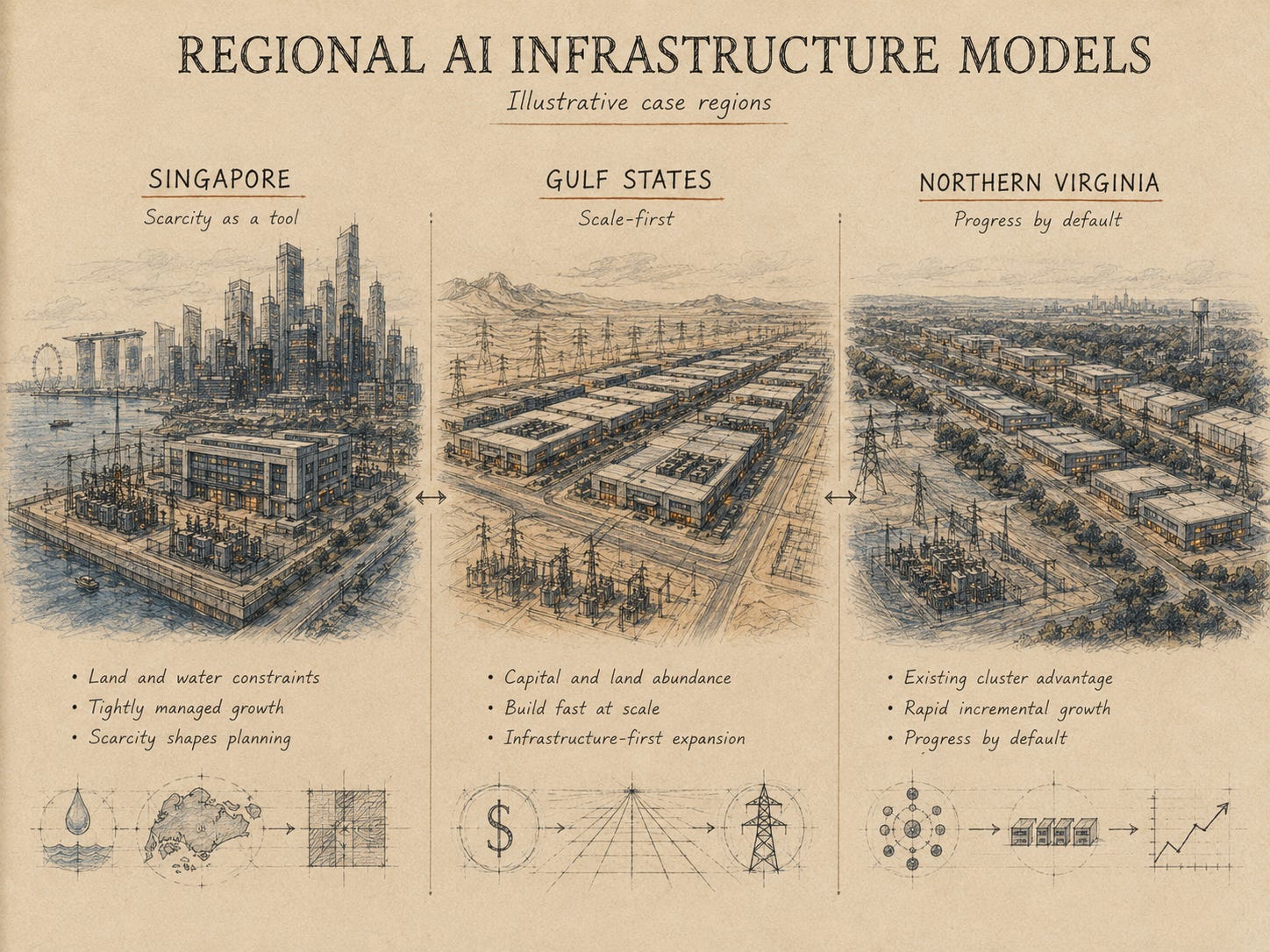
The most useful move, we think, is to stop treating energy, land, and labor as obstacles and start treating them as policy levers. Singapore’s data center moratorium did far from destroying its market. In fact, the moratorium forced operators to compete on efficiency and produced a more sustainable sector. Did Taiwan’s patient-capital model cost it global leadership? Not at all. It built a semiconductor ecosystem the world now depends on.
Constraints, deployed deliberately, shape the kind of ecosystem a region gets.
The deeper material is in the paper
There is more than a short essay can carry:
the full stakeholder analysis,
the case against blanket federal preemption,
the comparative cases (Taiwan, Singapore, the Gulf States, Northern Virginia, Texas), and
a five-question Deliberate Triad Choice Framework for making these calls in the open rather than by default.
The throughline is a conviction we keep returning to in The Frontier State project: a new technological frontier eventually demands a new form of governance. The buildout will run for decades, and the choices made now will shape its trajectory. The most consequential failures will come not from picking the wrong priority but from never making a deliberate choice at all, and letting the most well-capitalized actors decide by default.
Read the full paper: Harvard M-RCBG Working Paper No. 270, open access; paper published in AI & Society journal, part of the Springer-Nature publishing group.
Tushar Kanade is a DeepTech & innovation researcher, a 2025-26 Polymath Fellow, and a 2022-24 Aga Khan & Tata Scholar at the Harvard Kennedy School. He is the co-founder and host of The Frontier State, a series of leadership conversations and thematic essays exploring the intersection of venture capital, DeepTech, and technology policy. This essay is adapted from “The AI infrastructure triad in regional governance: how regions balance progress, sustainability, and equity”, co-authored with Paulo Carvão.
Paulo Carvão is a Senior Fellow at the Harvard Kennedy School Mossavar-Rahmani Center for Business and Government.
 | A guest post by
|